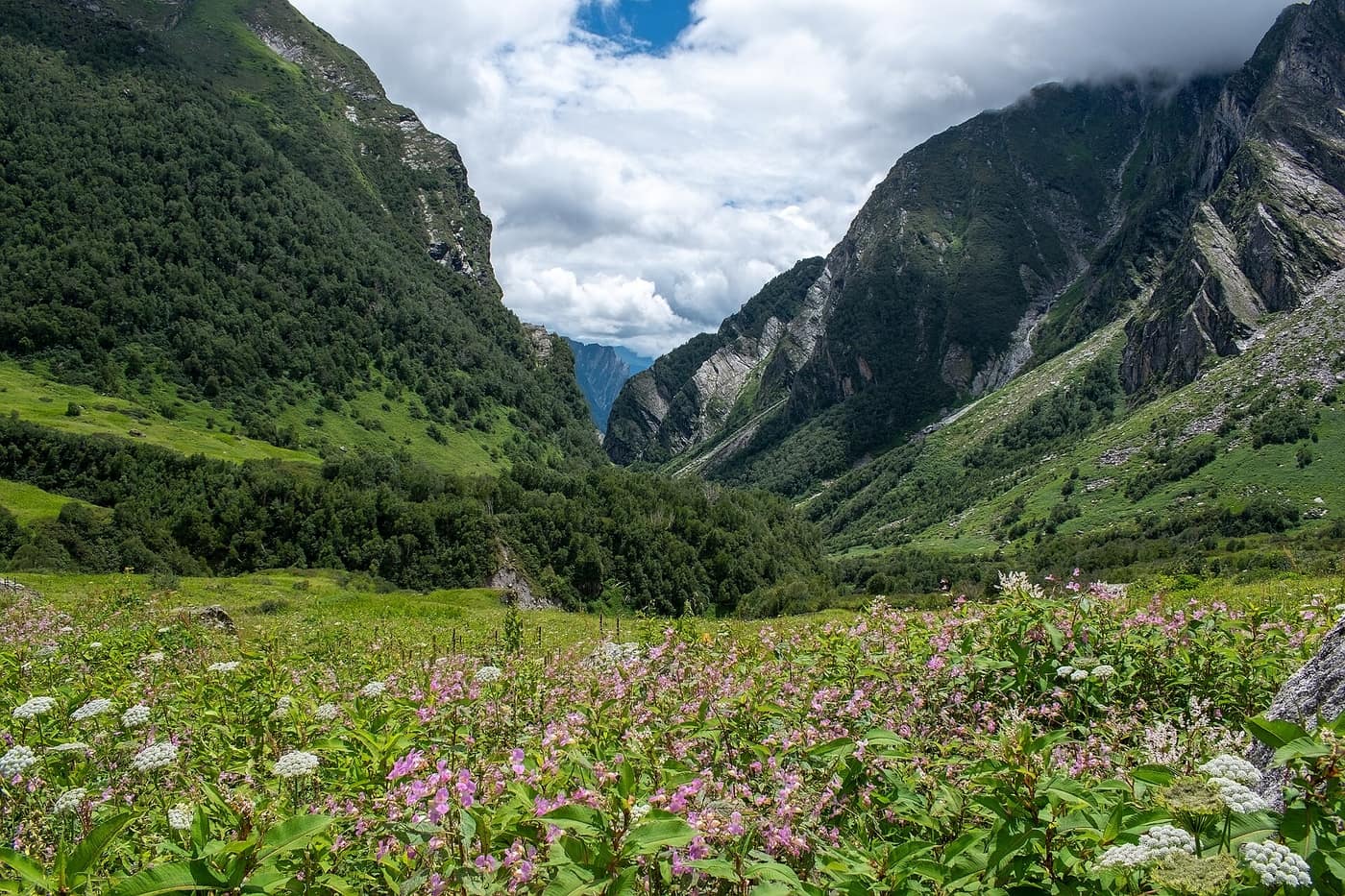
Valley of Flowers Trek
A UNESCO World Heritage valley where the meadows turn blue, pink and gold every monsoon
- Duration
- 6 days
- Total distance
- 38 km
- Highest point
- 4,329 m
- Difficulty
- Moderate
- Best time
- Jul - Aug
Overview
Valley of Flowers Trek
The Valley of Flowers is a high alpine valley in Chamoli, Uttarakhand, about 8 km long and 2 km wide, sitting at 3,350 to 3,650 m. You walk from Govindghat to Ghangaria, stay there, and visit the valley as a day trip. It opens only from June to October and blooms best from mid-July to mid-August. Most people add the climb to Hemkund Sahib. It is a moderate trek that fit beginners can do, alone or with a group.
- Starts at
- Govindghat (via Rishikesh)
- Ends at
- Govindghat
- Park open
- June 1 to October 31
- Total distance
- 38 km
In 1931 a group of British mountaineers led by Frank Smythe lost their way coming back from Mount Kamet and walked into a valley full of flowers. Smythe wrote about it in a book, and the name stuck. The Valley of Flowers National Park was created in 1982, and UNESCO listed it as a World Heritage Site in 1988, later joined with the Nanda Devi National Park in 2005.
The park has more than 500 kinds of flowering plants. The Pushpawati river runs through the middle, and snow peaks close the valley on every side. In 1939 a botanist named Joan Margaret Legge came here to collect plants and slipped to her death on the slopes. Her sister put up a memorial in the valley, which many trekkers visit.
The trek is different from most Himalayan treks because you cannot camp inside the park. You base yourself at Ghangaria, a small village where the Valley of Flowers trail meets the trail to Hemkund Sahib, and walk into the valley for the day. You must be out by 5 PM.
The walk from Govindghat is on a well-made stone path beside the Lakshman Ganga river, and it is busy with Sikh pilgrims and trekkers all season. The valley itself is gentle walking. What makes this trek tiring is the rain, the slippery stones and the height, not steep climbs.
Difficulty level
Moderate
Moderate. The 9 km climb to Ghangaria is steady but never technical, and the valley itself is gentle. The altitude (3,050 m to 3,500 m) and the rain are what tire people, so a fit beginner can do it with a rest day in hand. The optional Hemkund Sahib climb is steeper and reaches 4,329 m.
Why go
- 500+ kinds of alpine flowers in one valley, at their best from mid-July to mid-August
- The rare Himalayan blue poppy and the sacred Brahma Kamal
- Optional climb to Hemkund Sahib, one of the highest gurudwaras in the world
- Snow peaks above 6,000 m on every side of the valley
- Easy to do solo: busy trail, free gurudwara stays and cheap food on the way
- Fit beginners can do it. No technical climbing.
Short itinerary
- 1
Day 1: Rishikesh to Govindghat
~270 km by road · 10-11 hrs
- 2
Day 2: Govindghat to Ghangaria
9 km trek from Pulna · 1,830 m to 3,050 m · 5-6 hrs
- 3
Day 3: Valley of Flowers and back
8-10 km round trip · 3,050 m to ~3,500 m · 6-8 hrs
- 4
Day 4: Hemkund Sahib and back (optional)
12 km round trip · 3,050 m to 4,329 m · 8-9 hrs
- 5
Day 5: Ghangaria to Govindghat
9 km trek + jeep · 4-5 hrs
- 6
Day 6: Drive back to Rishikesh
~270 km by road · 9-11 hrs
Photos
What you will see
Himalayan blue poppy
Meconopsis aculeata
The famous sky-blue flower with a yellow centre. Look for it on rocky, open slopes in the upper valley.
Jul - Sep
Photo: Vinayaraj, CC BY-SA 4.0
Brahma Kamal
Saussurea obvallata
Cream-white bracts stacked like a lotus. It is the state flower of Uttarakhand and is easier to spot on the slopes towards Hemkund Sahib than on the valley floor.
Jul - Sep
Photo: Rohit Sharma, CC BY-SA 4.0
Cobra lily
Arisaema jacquemontii
A hooded green and purple flower that really does look like a cobra ready to strike. The photo shows a close relative, Arisaema speciosum, because clear photos of the local species are rare.
Jun - Aug
Photo: Sair18791, CC BY-SA 4.0
Marsh marigold
Caltha palustris
Bright yellow cups near wet ground and streams. One of the first colours you see.
Jun - Aug
Photo: H. Zell, CC BY-SA 3.0
Primula
Primula
Pink and purple clusters. Very common in damp patches along the trail.
Jun - Aug
Photo: Vihljun, Public domain
Himalayan bellflower
Campanula latifolia
Nodding violet bells that cover whole slopes in August.
Jul - Sep
Photo: Vinayaraj, CC BY-SA 4.0
Delphinium
Delphinium brunonianum
Tall spikes of deep blue-violet flowers standing above the grass.
Jul - Sep
Photo: Dmitry Kulakov, CC BY 4.0
Gentian
Gentiana
Small, deep blue trumpets. They open late, so they are best in late August and September.
Aug - Sep
Photo: Wikimedia Commons, CC BY-SA 4.0
Meadow geranium
Geranium
Pink to purple, five-petalled flowers with fine veins. Found almost everywhere in the meadows.
Jul - Sep
Photo: Rohit Sharma, CC BY-SA 4.0
Himalayan aster
Aster
Purple daisy-like flowers with yellow centres, common in late season.
Aug - Sep
Photo: Krzysztof Ziarnek, Kenraiz, CC BY-SA 4.0
Anemone
Anemone
White, delicate flowers close to the ground, especially in the early weeks of the season.
Jun - Aug
Photo: Dinesh Valke, CC BY-SA 2.0
Ligularia
Ligularia
Tall spikes with golden yellow daisy-like flowers, easy to spot along the river.
Jul - Sep
Photo: Alpsdake, CC BY-SA 4.0
Bloom times are approximate and change with each year’s rain and snow.
Peaks around you
Gauri Parvat
A big snow peak over 6,000 m that closes the valley. It is the one you will see in most photos.
Rataban
A sharp, pointed peak above 6,000 m, visible from the upper valley on a clear morning.
Hathi Parvat
Named after an elephant because of its rounded back. Look for it from the Ghangaria and Bhyundar side.
Photo: Sumodm, CC BY-SA 4.0
Nilgiri Parvat
A snow peak that shows up in clear weather, often at sunrise from the valley.
Photo: Sumodm, CC BY-SA 4.0
Saptashring peaks
Seven peaks ringing the glacial lake at Hemkund Sahib. You only see them if you do the Hemkund climb.
Photo: Praveen Negi, CC BY-SA 4.0
Birds and animals
Yellow-billed chough
CommonBlack birds with yellow beaks, seen in flocks near the trail.
Photo: Böhringer Friedrich, CC BY-SA 2.5
Himalayan monal
PossibleThe colourful state bird of Uttarakhand. Best chance is early morning on the slopes.
Photo: Pratap Gurung, CC BY-SA 4.0
Lammergeier
PossibleA huge bearded vulture that glides along the ridges.
Photo: Giles Laurent, CC BY-SA 4.0
Bharal (blue sheep)
PossibleSometimes seen on high grassy slopes, mostly towards Hemkund.
Photo: Wang.QG, CC BY 4.0
Himalayan musk deer
RareShy and mostly at night. Do not expect it.
Photo: Wang.QG, CC BY 4.0
Asiatic black bear
RareLives in the park but rarely meets trekkers. Never leave food open or go off the trail.
Photo: Dr. Raju Kasambe, CC BY-SA 4.0
Snow leopard
RarePresent in the high ranges, but a sighting is extremely unlikely.
Photo: Alfonsopazphoto, CC BY-SA 3.0
Off the beaten path
- 01History
Joan Margaret Legge's memorial
In 1939 Joan Margaret Legge, a botanist sent by the Royal Botanic Gardens, Edinburgh, came to study the valley's flowers and died here after a fall on a slope. Her sister put up a memorial near the stream, and it is usually described as being close to the valley's upper stretch. Most day visitors turn back before reaching it, and few know the story of the person the valley's plant records owe so much to.
Tip: Ask your guide or the forest staff at the gate to point out the exact spot. Location descriptions vary, so do not rely on a fixed distance.
Effort: Adds about 1-2 hours to the valley day
- 02River
Pushpawati river bed
The Pushpawati flows through the whole length of the valley, and its wide, stony bed is the quietest part. Walk to the edge of the trail and you get boulders, braided channels and the best views of the rock walls on both sides. Photographers like the early morning light here, when the trail is still empty.
Tip: Stay on the marked path and keep off wet boulders. The water is icy, fast and can rise after rain.
Effort: Short detour from the main trail; half an hour
- 03River
Ghangaria confluence
At Ghangaria the Pushpawati and the Hemganga (Lakshman Ganga) meet. Most trekkers cross the bridge at the village without stopping. A few minutes on the bank in the evening, with the noise of the two streams, is a calm end to the day.
Effort: 5-10 minutes from the village
- 04Village
Bhyundar village
Bhyundar is the last village on the trail, roughly 9 km from Govindghat, where the two valleys divide. The houses are built in the traditional style and the locals still grow crops here and take their sheep up in summer. It is where the trek passes through a living community rather than a campsite.
Tip: Buy tea or a snack from the local stalls. It is a small way of keeping money in the village.
Effort: Passes through on the way; no detour needed
- 05Shrine
Lokpal Lakshman temple
On the shore of Hemkund lake stands the small Lakshman temple. Many visitors arrive for the gurudwara, drink the tea, and go back without walking around the lake edge to see it. The stone is old and the lake is at its calmest early in the morning.
Effort: Included in the Hemkund Sahib day
Photo: Sumita Roy Dutta, CC BY-SA 4.0
- JanClosed
- FebClosed
- MarClosed
- AprClosed
- MayClosed
- JunGood
- JulPeak
- AugPeak
- SepGood
- OctOff-season
- NovClosed
- DecClosed
Month by month
- Jun
The park opens on June 1. Early bloomers like primula, anemone and marsh marigold, and snow patches on the upper trail. Fewer flowers than peak, but far fewer people.
- Jul
The monsoon arrives and the valley goes green. Flowers pick up from mid-July. Expect rain most days and a real risk of landslides on the road.
- Aug
The best month for variety. Blue poppy, Brahma Kamal, bellflowers and geraniums are all out. It is also the busiest month, so book beds early.
- Sep
Fewer flowers, but the rain eases and the peaks show up clearly. Good for photos of the mountains, and the crowds drop.
- Oct
Dry, golden meadows and cold nights. Very few flowers. The park closes on October 31.
Day-by-day itinerary
1Rishikesh to Govindghat
A long drive up the Alaknanda valley through Devprayag, Srinagar, Rudraprayag, Karnaprayag and Joshimath. Start at 5 to 6 AM. Landslides can stop the road for hours, so many people break the journey at Joshimath or Pipalkoti.
~270 km by road10-11 hrs2Govindghat to Ghangaria
Take a shared jeep from Govindghat to Pulna (4 km), then walk 9 km beside the Lakshman Ganga to Ghangaria. The path climbs steadily with tea stalls every few kilometres. Reach before the afternoon rain and book your bed first.
9 km trek from Pulna1,830 m to 3,050 m5-6 hrs3Valley of Flowers and back
Buy your ticket at the forest check post and enter the park after 7 AM. Walk along the Pushpawati river through the meadows. Most people go 4 to 5 km in and stop at the Joan Legge memorial. Be back at the gate before 5 PM.
8-10 km round trip3,050 m to ~3,500 m6-8 hrs4Hemkund Sahib and back (optional)
A steep 6 km climb of stone steps to the gurudwara and the glacial lake at about 4,300 m. Start by 6 AM. If you only want the valley, use this as a rest day or go back to the valley for a second visit, since your ticket is valid for 3 days.
12 km round trip3,050 m to 4,329 m8-9 hrs5Ghangaria to Govindghat
A 9 km downhill walk to Pulna and a short jeep to Govindghat. It is easier on the lungs but hard on the knees, so carry trekking poles. Stay the night at Govindghat or continue to Joshimath.
9 km trek + jeep4-5 hrs6Drive back to Rishikesh
Another long day on the road. Keep a buffer day if you have a flight or train, because monsoon landslides on the highway are common.
~270 km by road9-11 hrs
Map shows the Govindghat start point.Open full map ↗Google Maps ↗
The Valley of Flowers is one of the easiest Himalayan treks to do alone. Here is how it works step by step.
- 1
Get to Haridwar or Rishikesh
From Delhi, take an overnight bus or a morning train to Haridwar (roughly ₹200 to ₹700, about 5 to 6 hours). Rishikesh is 30 minutes further.
- 2
Take the earliest bus or shared taxi to Govindghat
Vehicles towards Joshimath and Badrinath leave from Rishikesh from about 4 to 5 AM. The full trip is 10 to 11 hours and costs roughly ₹600 to ₹1,000 by bus or shared taxi. If the road is slow, stop at Joshimath and take a shared jeep to Govindghat (about 20 km) in the morning.
- 3
Sleep at Govindghat
The gurudwara at Govindghat gives free beds and langar to pilgrims and trekkers. Small lodges nearby also have rooms. Buy a rain poncho and a walking stick here if you do not have them.
- 4
Walk to Ghangaria
Shared jeep to Pulna (₹50 to ₹80), then walk 9 km. There are tea and snack stalls all along. Go slowly and drink water. Reach by early afternoon and find a bed before the rain.
- 5
Buy your ticket and enter the valley
Carry a government photo ID. The forest check post is near Ghangaria. The ticket is valid for 3 days, so you can visit the valley twice. Entry is from about 7 AM and you must exit by 5 PM.
- 6
Add Hemkund Sahib if you can
Do it on a separate day. Start by 6 AM, carry a rain jacket, and cover your head at the gurudwara. Langar and hot tea are served at the top.
Solo tips
- There is no ATM at Ghangaria. Take enough cash from Rishikesh or Joshimath.
- Mobile network is patchy and electricity can go off. Carry a power bank and download offline maps.
- Gurudwara beds and GMVN beds fill up in July and August. Reach Ghangaria early, or book GMVN online in advance.
- The trail is busy in season, so you will rarely be alone. Still, tell someone your plan and check the weather each morning.
- You do not need a guide to enter the valley, but a porter or pony helps if you are carrying a big bag.
- Keep one buffer day at the end. Road blocks on the Badrinath highway can happen any time in the monsoon.
- Carry a light sleeping bag. Gurudwaras give blankets, but a personal sleeping bag is warmer and cleaner.
Govindghat
Gurudwara
GurudwaraFree (donations welcome)
- Simple dormitory-style halls, plus free langar (meals) and hot tea. Blankets are usually given, but do not count on it.
- First come, first served. Very simple, and shared with pilgrims.
- A good choice for the night before and after the trek.
Lodges and guesthouses
LodgeAbout ₹600 - ₹2,000 per room
- Basic rooms. Rates go up in July and August.
- Sharing a room with other trekkers brings the cost down a lot.
Ghangaria
Gurudwara (Hemkund Sahib Trust)
GurudwaraFree (donations welcome)
- Free stay and langar, the cheapest way to do the trek. Roughly the same set-up as Govindghat.
- Fills quickly in peak season, so arrive by early afternoon.
- Follow gurudwara rules: cover your head, no smoking, alcohol or non-veg.
GMVN Tourist Rest House
GMVNDorm beds from a few hundred rupees, rooms about ₹1,500 - ₹3,000
- Run by Garhwal Mandal Vikas Nigam. Dorm beds are the best paid option for solo travellers.
- Book in advance for July and August on the GMVN website. Check current rates when you book.
- Simple canteen with fixed-menu meals.
Private hotels and lodges
LodgeAbout ₹1,500 - ₹4,000 per room in peak season
- Small hotels line the main lane. Rooms are basic and facilities are modest because of the remote location.
- Many include dinner and breakfast. Ask before you pay.
- Prices jump in July and August and fall in September.
Swiss tents and camps
CampAbout ₹2,000 - ₹3,500 per person with meals
- Tents pitched next to the village. Meals are usually included.
- Camping is not allowed inside the national park, only in Ghangaria.
Approximate ranges for 2026. Prices change with season and demand, so treat them as a guide.
Backpacker (solo, DIY)
₹4,000 - ₹7,000
per person
Bus, shared taxi, gurudwara or dorm stays, langar and dhaba food. From Delhi, 6 to 7 days.
- Delhi to Rishikesh and back
- Rishikesh to Govindghat and back
- Free gurudwara or dorm stay
- Entry ticket and basic food
Independent, more comfort
₹9,000 - ₹15,000
per person
Private lodges, meals in Ghangaria, a pony or porter for a day. From Rishikesh.
- Private room, shared or single
- All meals on the trail
- Pony or porter for one leg
- Entry ticket
Guided group trek
₹9,000 - ₹25,000
per person
From Rishikesh or Haridwar, 6 days. Big group operators charge ₹9,000 to ₹14,000 plus GST. Private agencies with better rooms charge more.
- Transport from Rishikesh or Haridwar
- Stays and all meals
- Trek leader and first-aid support
- Permits usually included
Where the money goes (per person)
- Delhi to Haridwar or Rishikesh (bus or train)
- ₹200 - ₹700
- Rishikesh to Govindghat, one way (bus or shared taxi)
- ₹600 - ₹1,000
- Jeep, Govindghat to Pulna, each way
- ₹50 - ₹80
- Valley of Flowers entry, Indian nationals (valid 3 days)
- ₹150 - ₹200
- Stay per night at a gurudwara
- Free
- Stay per night, GMVN dorm bed
- A few hundred
- Stay per night, private room at Ghangaria
- ₹1,500 - ₹4,000
- Food per day if you skip langar
- ₹400 - ₹800
- Pony, Pulna to Ghangaria (optional)
- ₹1,900 - ₹2,500
- Porter, to the valley or Hemkund (optional)
- ₹1,300 - ₹1,900
- Helicopter, Govindghat to Ghangaria, one way
- ₹3,500 - ₹4,500
- Rain poncho, walking stick, snacks
- ₹300 - ₹700
How to reach
- Nearest airport: Jolly Grant, Dehradun. Nearest railheads: Haridwar and Rishikesh.
- From Rishikesh, take the earliest bus or shared taxi to Govindghat. It takes 10 to 11 hours.
- Joshimath is the last big town with ATMs, shops and a hospital.
- From Govindghat you walk. Ponies, porters and a helicopter to Ghangaria are available.
Permits, fees and rules
- The park is open from about June 1 to October 31 and can close in bad weather.
- Entry is from about 7 AM, and you must be out by 5 PM.
- Buy the entry ticket at the forest check post near Ghangaria. Carry a government photo ID.
- Foreign nationals pay a higher fee. Check the latest rates at the gate.
- No camping and no overnight stay inside the park.
What to pack
- Good rain jacket or poncho, and a rain cover for your bag
- Broken-in trekking shoes with good grip
- Trekking poles (a big help on the descent)
- Warm layers, and a down jacket if you are going to Hemkund
- Sunscreen, sunglasses, cap, quick-dry clothes
- Power bank, torch, and cash
- Personal medicines, ORS and a basic first-aid kit
Signal is patchy or absent above Govindghat. Download these before you leave.
Gaia GPS
Free + paidAndroid, iOS
Offline topographic maps and GPS tracks.
Tip: Download the map for Govindghat to Hemkund at the hotel, because there is almost no signal on the trail.
Visit website ↗Organic Maps
FreeAndroid, iOS
Free offline maps with hiking trails and viewpoints.
Tip: A good free back-up to Gaia. Download the Uttarakhand region before you leave.
Visit website ↗Merlin Bird ID
FreeAndroid, iOS
Identify birds by photo or by the sound of the call.
Tip: Download the South Asia bird pack while you have Wi-Fi. Then it works offline.
Visit website ↗iNaturalist
FreeAndroid, iOS
Record plants and animals you see and get help identifying them.
Tip: Your observations are saved offline and uploaded once you are back in signal. It helps scientists too.
Visit website ↗Seek by iNaturalist
FreeAndroid, iOS
Point your camera at a flower to get a name, with no account needed.
Tip: Works offline for the common species. Use it for the flowers in this guide.
Visit website ↗IMD Mausam
FreeAndroid, iOS
Official India weather forecasts and warnings.
Tip: Check it at Govindghat and again in Joshimath. Landslides are common in monsoon.
Visit website ↗
Listed for reference. Not paid partners. Check prices and dates on their website.
- I
Indiahikes
Well-known trekking organisation. Runs the Valley of Flowers trek from a base camp at Karchi/Dhak with trek leaders and a safety-first approach.
Listed at about ₹13,950 + GST (Karchi to Karchi) on their site at the time of writing.
Visit website ↗ - T
Trek The Himalayas
Offers a Valley of Flowers trek combined with Hemkund Sahib and Badrinath.
Visit website ↗ - H
Himalayan Hikers
Guided Valley of Flowers departures with itinerary, cost and safety details on their page.
Visit website ↗ - H
Himalayan Dream Treks
Valley of Flowers trek departures from Uttarakhand; see their page for dates and inclusions.
Visit website ↗
What is the best time for the Valley of Flowers trek?
Mid-July to mid-August is peak bloom, and August is the best month for variety. July is less crowded, and September has fewer flowers but clearer mountain views. The park is closed from November to May.
Can I do the Valley of Flowers trek solo?
Yes. It is one of the easier Himalayan treks to do alone. The path is well made, busy with pilgrims and trekkers in season, and you do not need a guide to enter the park. Book a bed at Ghangaria early, carry cash, and start each day early.
How much does the Valley of Flowers trek cost?
A solo backpacker doing it on gurudwara stays and simple food can manage it in roughly ₹4,000 to ₹7,000 from Delhi. A comfortable independent trip is about ₹9,000 to ₹15,000, and guided group treks cost roughly ₹9,000 to ₹25,000 from Rishikesh.
How many days does the Valley of Flowers trek take?
Plan 5 to 6 days from Rishikesh, including 2 days of driving. If you skip Hemkund Sahib, it can be done in 5 days.
How difficult is the Valley of Flowers trek?
It is rated moderate. The climb to Ghangaria is long but steady, and the valley walk is gentle. Hemkund Sahib is the tough part, with a steep climb to about 4,300 m.
Can I camp inside the Valley of Flowers?
No. Camping and overnight stays are not allowed inside the national park. You stay at Ghangaria and visit the valley as a day trip.
Will I see Brahma Kamal in the Valley of Flowers?
You may see it, but it grows higher up, so the best chance is on the slopes towards Hemkund Sahib from late July to September. In the valley itself, the blue poppy is the star.
Is there mobile network and an ATM at Ghangaria?
There is no ATM, so carry cash from Rishikesh or Joshimath. Mobile network is patchy, and electricity can go off. Carry a power bank and download offline maps.
Is the Valley of Flowers trek safe in monsoon?
It is done every monsoon, but landslides and road blocks are common on the Rishikesh to Govindghat road. Keep buffer days, start walking early each day and follow local weather advice.